I.R.S. RECORDS
"Miles [Copeland] is betting on himself and I'll always bet on a guy who bets on himself."
--Jerry Moss, Record World, March 8, 1980
"Success is based on what we spend and what we get back.
We think it takes at least three albums to make a group successful.
They have to learn the workings of a studio, the workings of the business, they have to educate themselves.
And the market has to learn about them; they have to build a following.
We consider ourselves a very conservative record company, in that we gear ourselves to make money on every record, but we gear ourselves also so the groups make money on every record....
Every [group] is treated in a different way, and [the deal] is determined by what the group wants to do,
what they're capable of doing, and what we're capable of doing."
--Miles Copeland, Record World September 12, 1981
"When I listen to a tape...I think 'I'd like to be associated with that.'
I'm putting out records I like; I actually play my records and I can sing you all of the songs."
--Miles Copeland, Cash Box September 12, 1981
1970s: MILES COPELAND'S RECORD LABELS
Miles Axe Copeland, III began his career in the music industry as an agent and manager in England. In 1977, he founded Illegal Records, Deptford Records and Step Forward Records in Great Britain with artists from the punk, punk rock and new wave genres. In the late 1970s, Miles managed U.K. Squeeze, The Police, The Buzzcocks, Chelsea, The Fall and Alternative TV.
Brother Ian Copeland established Frontier Booking International (F.B.I.) in the late 1970s. In 1978, he brought The Police, Squeeze and the Buzzcocks to the United States. None of the bands were signed to a record label. Copeland arranged low-budget tours for them in small venues primarily on the east and west coast. His tour philosophy was similar to Miles' approach to records: the tour should pay for itself and generate a profit. Tours built the artist's audience. Ian kept an accounting of each band's audience in each venue to help calculate its value at future performances. The first tour by The Police was the widely publicized U.S. tour with Ian driving the van, no roadies, and shared hotel rooms. Ian acted as a concert promoter. He would get the equipment, book the dates, get radio ads, contact radio stations.
Miles told Cash Box, "I had established a good track record with A&M England. I brought them Squeeze at a time when they needed a young act, having just been burned by the Sex Pistols and the Stranglers, who went out of their way to offend everybody. We toured and made a good impression on everyone. Then I brought them The Police, toured them without a record, and showed them you could break an act without spending a fortune. So finally, when I came to Jerry Moss with the I.R.S. concept, I made it clear it was an opportunity he couldn't afford to pass on." (March 18, 1980)
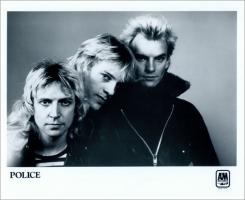
Miles Copeland took second single from The Police "Roxanne" to A&M Records, Ltd. A&M liked it and in March 1978, The Police signed a worldwide agreement with A&M Records in England. The single of "Roxanne" was their first release arriving in April in Britain. BBC Radio refused to play a song about a prostitute. Despite the BBC ban, the single sold about 10,000 copies. Thanks to the strength of the single and album in the U.S. A&M Ltd. reissued the "Roxanne" single in April 1979. The re-issue charted peaking at #12. In the U.S. the song was released as a single around August 1978 and it was also included on the A&M new wave compilation No Wave.The single peaked at #2 on the Billboard Pop Singles chart. Ian had The Police tour in the U.S. just before the release of the Outlandos d'Amour album in November. They played big cities on weekends and small venues on weeknights. This tour broke The Police in the U.S.
Miles Copeland met with Jerry Moss with a concept for a new record label. In July 1978, A&M Records (United States) agreed to manufacture and distribute I.R.S. Records products. At the time, Jay Boberg worked for A&M Records as a college representative. One of the bands he promoting was The Police. In early 1979, Boberg joined I.R.S. Records. Initially Copeland and Boberg drew on the bands from the various labels Miles had in Britain. These labels were:
Buzzcocks Records
Deptford Fun City Records (Alternative TV, Henry Badowski, Squeeze. The label was created for the first singles by Squeeze and Jools Holland.)
Fashion Music (Fashion)
Illegal Records (Founded in 1977 to manufacture and distribute first Police single "Fall Out/Nothing Achieving." Miles Copeland designed the label's logo. The label ran until about 1991. Illegal distributed BJ Records (Brian James' initials). Its artist roster included John Cale, The Cramps, The Humans, Lords of the New Church, R.E.M., Skafish, Root Boy Slim, and Wazmo Nariz.)
Industrial Records (Operated from 1976-1981 with artist Throbbing Gristle)
Rough Trade Records (Dream Syndicate, The Fall, The Monochrome Set)
Step Forward Records (Founded 1977 by Copeland and Mark Perry. Featured artists Chelsea, The Fall. The Fall had the longest tenure with the label thanks to its established audience. .)
Spy Records (Owned by John Cale and distributed by Miles Copeland. Featured artists: John Cale, The Necessaries)
Until I.R.S. and A&M Records (U.S.) signed a distribution agreement in mid-1979, I.R.S. products in the U.S. were all imported from England. The first U.S. singles and EPs were released in August 1979 (Buzzcocks, Monochrome Set, Brian James, Fashion, The Necessaries, Throbbing Gristle, Chelsea, Wazmo Nariz and The Cramps). The first albums were The Singles by the Buzzcocks, Product Perfect by Fashion, Things Aren't Right by Wazmo Nariz, Zoom by Root Boy Slim, The Best Of Alternative TV, and Live by John Cale.
"The record companies were started because we couldn't get major companies to pay any attention....We say we need 30 grand to break an act in America and the record companies say no. So what we wanted to do was work out a system that was cheap and break that Catch 22 where we could get the ball rolling and recoup those costs."
"We do like to be adventurous with our music and we also like cult things because they are a safer investment. There tends to be a sure market for them. For example, if the recording costs are reasonable I know I will make money back on The Cramps because the cult is very loyal."--Miles Copeland in Music Week October 25, 1980
The first I.R.S. Records releases in the U.S. under the agreement with A&M appeared in August 1979. Boberg coordinated the distribution and promotion of those albums. Copeland and Boberg expanded the artist roster with Henry Badowski, The Cramps, Brian James and Wazmo Nariz signed to I.R.S. Records in 1979. Fashion signed in November 1979.
A&M Records had no ownership in I.R.S. A&M's role in the agreement was for A&M to make all I.R.S. records available to radio and retail. A&M had the option to help promote records by artists who showed signs of breaking in return for royalties in A&M's favor. There was no agreement that a successful artist would transfer to the A&M roster. A&M also provided office space in Los Angeles and New York, free postage, and shared the cost of record manufacturing. I.R.S. would do its own marketing and advertising. This agreement gave Copeland creative freedom and access to A&M's sales and promotion operations
Carl Grasso came to I.R.S. with responsibility for art direction, package design, layout, and other visual media. The combination of Copeland's idea for a company and his management, coupled with the expertise of Boberg and Grasso developed the label making it one of the most successful of its genre. Both Boberg and Grasso agreed to stay with I.R.S. for five years. In return for fulfilling their agreements, they became principal owners of I.R.S. Records.
Under Miles' leadership, the I.R.S. philosophy on signing artists and financing recordings was to treat each artist and recording project individually. I.R.S. developed a reputation as being tight-fisted with money, however, the label would spend when it believed it would be profitable for the artist and label. If an artist had offers from several labels, I.R.S. stayed with its offer. What it might not offer in money, I.R.S. offered in access to all of its departments and staff giving the artist more time and personalized support than might be had at another label. I.R.S. believed its approach could mean more record sales resulting in making more money in the long run.
Copeland also established a number of music publishing divisions including Bugle Music Publishing and Bugle Songs, Ltd., Illegal Songs, I.R.S. Music, I.R.S. Songs, and Firstars Music. All of the divisions were ultimately housed under the Bugle Publishing Group.
Still later, with Mike Gormley, Miles Copeland created Los Angeles Personal Direction (L.A.P.D.), an artist management company. Now Copeland could offer artists a complete package management, booking, recording and music publishing. Typically, all of Copeland's businesses had offices in Los Angeles and London. His music publishing concern also had offices in Nashville.
The I.R.S. Man logo was first used commercially in September 1979. It was filed with the U.S. Patent and Trademark Office on June 17, 1982 and was registered on July 12, 1983. I.R.S. also trademarked the word "Cassingle." Its first commercial use was June 22, 1982. It attained trademark registration status on June 28, 1983.
From 1979 until 1981, I.R.S. Records used a white label ringed by a rainbow. From 1981 until 1985, its labels were silver with a maroon I.R.S. Man at the lower left edge. Most record labels were customized with the band logo or art.
1980s: I.R.S. RECORDS IN THE U.S.
1980
Andrea Accardo was hired away from A&M Records as I.R.S.' national publicity director. Bob Laul was the national director of sales. Michael Plen moved over from A&M to be the national director of promotion. Carl Grasso was hired as the Vice President of creative affairs (art and graphics). Gabrielle Powell was the director of artist relations and administered I.R.S. music publishing. Michael Grant was the director of tour publicity.
From release in September 1979 to March 1980, the Buzzcocks Singles Going Steady sold 35,000 units; A Different Kind of Tension shipped 16,000 units, and John Cale's Sabotage Live had sold 30,000 copies. All other albums had sold about 7,500 to 12,500 units. Based on the strength of Cale's sales, he moved to the A&M Records roster.
I.R.S. felt college radio playlists had to different from commercial stations in the same market in order to get attention. I.R.S. Records began offering $25 annual subscription service for college radio. All new releases, promotion materials, artist itineraries and back catalog were available to participants. I.R.S. also coordinated the promotion it did with colleges to artist touring schedules. I.R.S. realized that people who attended concerts might have only learned about the artist because of the promotion. Promotion increased audience size and record sales.
In-store promotion included the "Free Money Campaign" that offered $1.00 off each album. Store personnel wore tee shirts that read "I.R.S. says Free Money" and I.R.S. buttons were given to customers. Another promotion was the "Tax Relief Fund" contest with the winner having their taxes paid by I.R.S. Records.
Berlin, The Dead Kennedys, The Go-Go's and Oingo Boingo signed in 1980. The Go-Go's would become I.R.S. Records biggest-selling act. The Go-Go's was a four-way equal partnership. Newcomers Oingo Boingo and The Buzzcocks each had a Billboard Top 100 album.
The Dead Kennedys were the reason Copeland started the Faulty Products label in 1980. Faulty's address was just a few blocks from A&M at 633 N. LaBrea, Suite A. The Dead Kennedys' Fresh Fruit for Rotting Vegetables was released on Alternative Tentacles, sister label of Faulty Products. Part of the A&M/I.R.S. agreement was that A&M could elect not to promote I.R.S. products. A&M passed on The Kennedys album (SP 70014, Fresh Fruit for Rotting Vegetables) and single (IR 9016, Police Truck/Holiday in Cambodia) because it felt the group's name was in poor taste. The stock numbers listed here were within the I.R.S. album and singles series A&M used.
1981
Jay Boberg was made the vice president for North American Operations. Barbara Bolan was the west coast sales manager. Carl Grasso was the Vice President of creative affairs. John Guarnieri was production coordinator. Bob Laul was the national director of sales and the New York office's operations. Michael Plen was the national director of promotion. Gabrielle Powell was the director of artist relations. Michale Grant was the national director of publicity. David Zislis became director of business affairs. Lauren Manduke was the national director of college promotion (radio and publicity). Ron Felmus was the club promotion coordinator. The label now had a staff of 12 and a third office in Dallas, TX.
I.R.S. and A&M renegotiated their distribution agreement.
"Walk Into Spring and Walk Away With the Hits" was the retail and radio contest that promoted the double album of I.R.S. Records Greatest Hits.
Faulty Products began to distribute and to import records directly to American retail. It served as a testing ground to see if products were viable for A&M to distribute. Faulty used its own network of independent distributors. The first recording from Faulty Products was the Dead Kennedy's "Holiday in Cambodia." The Dead Kennedys also had an 8-song E.P. titled In God We Trust, Inc. It was released as a joint venture of Alternative Tentacles and Faulty Products. Faulty Products Records artists were the Textones, Tea Time, Steve Diggle and the Cramps. Bob Laul was named Vice President of Faulty Products. John Guarnieri was the western (U.S.) sales manager for Faulty Products. I.R.S. felt college radio playlists had to different from commercial stations in the same market in order to get attention.
Developed 30-second television spots to promote Wall of Voodoo.
I.R.S. entered into distribution agreements with CBS Australia and CBS New Zealand. The first records from that deal were the Cramps Songs the Lord Taught Us, Things Aren't Right by Wazmo Nariz, and the self-titled Skafish album. I.R.S. also created a sampler album that contained two songs from each of theses albums, a poster for radio and a print ad campaign announcing I.R.S. Records.
Alternative TV, Magazine and Renaissance signed to I.R.S. in 1981. The Bangles signed to Faulty Products because neither Copeland nor the group wanted The Bangles on the same label as The Go-Go's. Their EP was originally released on Faulty and reissued by I.R.S. in 1983. Also, future Gold Mountain Ltd./A&M artists The Textones recorded a single for Faulty Products.
In 1981, I.R.S. was confronted with legal disputes brought by The Cramps and The Go-Go's.
In mid-March, the Go-Go's debut album was released. It was promoted with album flats, poster, five Go-Go's buttons and a browser box for retail. Beauty and the Beat became the first RIAA gold certification for I.R.S. The Go-Go's claim the distinction of being the first all-female band to have a #1 album on the Billboard Pop Chart. The group was the only artist from I.R.S. ever nominated for Grammy® awards (1981 as Best New Artist and in 1982 their Vacation album was nominated in the Best Album Package category). In 1981, they also had a Top 10 and Top 20 single on the Billboard Pop Singles chart. Billboard named the Go-Go's the #22 Best New Album Artist and #9 Best New Duo/Group Album Artist in its annual Number 1 Awards. Artists The Fleshtones, Renaissance and Wall of Voodoo each had a Billboard Pop 200 album.
In March, A&M Records, Ltd. and I.R.S. Records completed a marketing and distribution deal for the UK and Ireland. Miles Copeland and A&M Records, Ltd. in London agreed to a marketing and distribution agreement for the UK and Ireland. Copeland told Music Week, "This represents an extension of our existing relationship within the UK and gives A&M in the UK access to some of the best new talent in the US."
1982
Barbara Bolan was promoted to national director of sales. Keith Altomare was named the national director of college promotion. Michael O'Brien became the director of business affairs. Kevin Sutter assumed the position of eastern director of sales. Karen Kelly was the tour coordinator/tour publicist. Steve Tippled was the director of dance club/video promotion.
Miles Copeland and Mike Gormley established the L.A. Personal Direction (LAPD) management company. Gormley had been A&M Records VP of Communications and Assistant to the Chairman, Jerry Moss. His new position also included consulting I.R.S. on publicity. Copeland needed a manager in Los Angeles because he was working mainly from New York and London. LAPD's first office was at 633 N. LaBrea Avenue, Suite A, Hollywood, CA. Oingo Boingo and Wall of Voodoo were the first acts signed by LAPD.
In January, the Go-Go's live video "Totally Go-Go's" was made available for syndication. It was filmed on December 5, 1981 at Palas Verdes High School.
In February and March, Cash Box reported the Dead Kennedys were to have a new record. Thom Wilson was the producer and recording was at Hyde Street Studios in the San Francisco Bay Area. The album was never released. There was also speculation that A&M might distribute the Dead Kennedys but A&M decided it would not even manufacture it.
The first picture disc was a 7-inch of the Go-Go's "We Got the Beat/Our Lips Are Sealed." It retailed for $4.98 and was supported in stores with a countertop browser box.
On May 25, I.R.S. launched its midline series with Singles Going Steady and A Different Kind of Tension as the first albums with a sticker "Midline Series $5.98--Cheaper."
In August, the English Beat signed with I.R.S.
The Bangles signed with Faulty Products and were managed by L.A.P.D.
I.R.S. serviced its promotional video clips to 30 clubs and 20 cable stations around the United States. I.R.S. also used the clips as part of its retail distribution to introduce new groups.
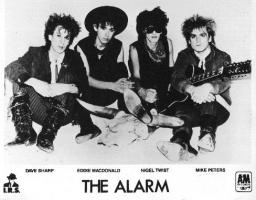
In 1982, Jools Holland hosted a one-hour show on MTV called "The I.R.S. Show." Holland interviewed British and American new wave bands. "The I.R.S. Show" became the pilot for "I.R.S. Records' The Cutting Edge" music and interview television program. Developed for MTV, it was an hour-long show that aired on the last Sunday of the month. It first appeared on May 29, 1983. Peter Zaremba of The Fleshtones hosted the show. That first show featured the world premiere of the video "Talking to a Stranger" by Hunters and Collectors, then artists with A&M. Among the I.R.S. and A&M artists who were guests on the show were The Alarm, The Bangles, Iggy Pop and Suzanne Vega.
I.R.S. Records introduced the cassingle (cassette single) with a retail price of $2.98. The first one to be test marketed was the Go-Go's "Vacation" in Atlanta. It went on to sell 25,000 copies.

The Cosmetics, English Beat, the Lords of the New Church and R.E.M. signed to I.R.S. in 1982. The Humans had a 47-minute promotional film of their song "Happy Hour" and were signed in December 1982. The Go-Go's were back on the Billboard Pop album and singles chart with both a Top 10 album and a Top 10 single. The RIAA granted a platinum certification for their Beauty and the Beat album--the first platinum record for I.R.S. English Beat and R.E.M. both had Top 40 albums. Wall of Voodoo had a Top 200 album and a Top 100 single and shot their video of "Mexican Radio" in Tijuana, Mexico.
The Dead Kennedys recorded an album for I.R.S. in March 1982 at Hyde Street Studios in San Francisco. John Cuniberti engineered the sessions and Thom Wilson produced them. None of the Dead Kennedys recordings were released through the distribution deal with A&M Records.
Among the earliest promotional videos were The Go-Go's "Vacation" and The English Beat's "Save It for Later."
In July 1982 the Lords of the New Church and R.E.M. signed with I.R.S. Records.
BILLBOARD TALENT IN ACTION 1982
| CATEGORY | ARTIST | TITLE |
|---|---|---|
| Top Pop Artists | 1. Go-Go's (6) | |
| Top Pop Albums | 2. Go-Go's | Beauty and the Beat |
| Top Pop Album Artists Duos/Groups | 1. Go-Go's (2) | |
| Top Pop Singles Artists | 6. Go-Go's (4) | |
| Top Pop Singles Artists--Duos/Groups | 9. Go-Go's (4) | |
| Top Pop Singles | Go-Go's (4) | 25. We Got the Beat 63. Our Lips Are Sealed 87. Vacation |
1983
Kyle Hetherington became the associate director of radio promotion for the west coast. Keith Altomare was promoted to associate director of radio promotion/east coast. Alice Culver was hired as the director of college radio/dance club and video promotion.
On May 1, I.R.S. opened an office that worked out of A&M Records' Des Plaines office. It serviced the Midwest and part of the South. Keith Altomare was named to run the new office. I.R.S. wanted to establish itself as a major independent label making it important to have people in the area to work with radio, retail and clubs.
Signed the Animals to a two-album deal, one studio and one live album. The Alarm and Barry Diamond alsonsigned in 1983.
In January, the Go-Go's reached an out of court settlement with I.R.S. The label had sued the group claiming it had the right to terminate their contract based on a dispute over the label's payment of advances to them.
The music industry was undergoing major changes, particularly in record distribution. The independents struggled to stay in business as the large record labels had brought distribution in-house. I.R.S. had some distributors that went out of business and others that had fallen behind in paying I.R.S. for its products. As a result, I.R.S. closed Faulty Products and relied on its distribution via A&M Records. The closure affected Faulty's 13 employees. Six employees were picked up by I.R.S. or its new film company.
Miles, Ian and Stewart Copeland formed a film and television production company, Copeland & Power with Derek Power. I.R.S. Video Corp. was formed during the summer of 1983. The first releases were The Police Around the World, a R.E.M. concert and a "best of" compilation from the Cutting Edge television series.
The Alarm had a Top 200 Billboard Pop album while the Animals charted with two Top 100 albums and one Top 100 single. I.R.S. artists back on the Billboard Pop Charts were The English Beat with a Top 100 album and R.E.M. with a Top 100 single.
I.R.S. Records developed a monthly alternative music television series on MTv titled "The Cutting Edge." The first episode aired on April 17, 1983. The one-hour shows featured taped profiles of band members, videos, pieces on the recording industry, plus a look at the audience and culture. Several groups were filmed on the A&M/Charlie Chaplin Soundstage. The show also featured artists who were not on the I.R.S. roster.

I.R.S. Video was announced and was working on videos for all of the artists and coordinating simultaneous releases of recordings and videos. It was also exploring other video forms. I.R.S. Video was a partnership between I.R.S. Records and Copeland & Power. Its first home video release was "Police Around the World."
1984
Paul Orescan hired to I.R.S. Records Canada for product and promotion. Loren Gerson became the national college promotions director and east coast video promotion director. Michael Plan was Vice President of promotion. Jay Boberg was promoted to president of I.R.S. Records and Miles Copeland became the chairman of I.R.S.
1984 was I.R.S.'s best year on the Billboard Pop chart--nine albums and four singles by seven artists. Four of the albums were Top 40. Leading the label on the charts were the Go-Go's with a Top 20 and a Top 40 album plus Top 20, Top 40 and Top 100 singles. R.E.M. had a Top 40 album and a Top 100 single and The Alarm contributed two Top 100 albums.
BILLBOARD TALENT ALMANAC 1984
| CATEGORY | ARTIST | TITLE |
|---|---|---|
| Top Pop Album | 50. Go-Go's 70. R.E.M. | Talk Show Reckoning |
| Top Pop Album Artist | #58. Go-Go's (1) #75. R.E.M. (2) 94. The Alarm (2) | |
| Top Pop Singles Artist | 92. Go-Go's (2) | |
| Top Pop Singles | 88. Go-Go's | Head Over Heels |
Miles Copeland also worked his magic in film and television. He was the executive producer for Urgh! A Music War (soundtrack on A&M Records), and in negotiations with MTV that gave The Police the distinction of being the first act the network sponsored as well as a Police television special exclusive to MTV.The television productions required their own management division, Copeland, Copeland, Copeland and Powell (C.C.C.P.) In 1986, it was expanded to a two-hour format and was renamed. The series ran for five years. Two video collections from the show remain available, "The Best of the Cutting Edge Highlights from the Series" volumes one and two.
"Be(a)st of I.R.S. Video" a compilation tape of ten videos by ten artists was released in 1984.
1985
Tom Corson promoted to the director of west coast promotion. He had been the director of west coast sales. Michael Rosenberg became the east coast sales director. Larry Reisman became the director of west coast operations.
Concert vides released by I.R.S. in 1985 were "Police Around the World" in 1983 and "Prime Time Go-Go's".
I.R.S. Records left its distribution agreement with A&M at the end of April 1985. I.R.S. cited its need for more financial backing than A&M could provide. A&M continued to distribute current and back catalog. I.R.S. officially joined MCA Records on May 3. In England A&M Records Ltd. and I.R.S. Records issued a joint statement that said the distribution agreement would end in March 1985. They cited the same reasons as the statements given in the U.S.
By then, the Go-Go's had produced three gold albums and two platinum albums and they were the best-selling act on I.R.S. Records. R.E.M. had given I.R.S. two gold albums. The label had released 109 albums, 68 7-inch singles and 18 12" singles. The back catalog and two current albums continued to be distributed by A&M.
I.R.S. Records and A&M Records ran a full-page ad in the December 1989 (page 93) DISCoveries magazine, "Responsible major label reissue program. Including, wherever possible: [1] material never before available on CD; [2] rare and previously unreleased tracks, [3] unpublished photos and new liner notes." The ad included photos of 15 A&M and I.R.S. CDs with notes about the additions for these first edition CDs. For I.R.S., these were:
The Cramps, Songs That the Lord Taught Us, original album with four alternate versions of songs and one unreleased song.
The Cramps, Psychedelic Jungle/Gravest Hits, second album and EP.
The Buzzcocks, A Different Kind of Tension/Parts 1-3, album plus the group's last three singles.
Let's Active, Cypress/Afoot, their first EP and first album, the song Grey Scale, and one unreleased song.
The Fleshtones, Living Legends Series, unreleased and rare tracks with highlights from all of their I.R.S. albums.
>Urgh! A Music War with unavailable live material by The Police, The Cramps and other artists.
The Dream Syndicate, Medicine Show/This Is Not the New Dream Syndicate Album...Live!
The I.R.S. back catalog of some recordings continued active and was reissued by A&M until 1990. By 1990, I.R.S. was under EMI Records. In 1994, EMI bought I.R.S. for an estimated $20 million.
I.R.S. Records officially closed its doors on July 11, 1996.
Bugle Publishing Group had 1,000 songs in its catalog in 1997. Copeland sold it to Rondor Music International.
CHANGES TO THE I.R.S. RECORDS DISCOGRAPHY
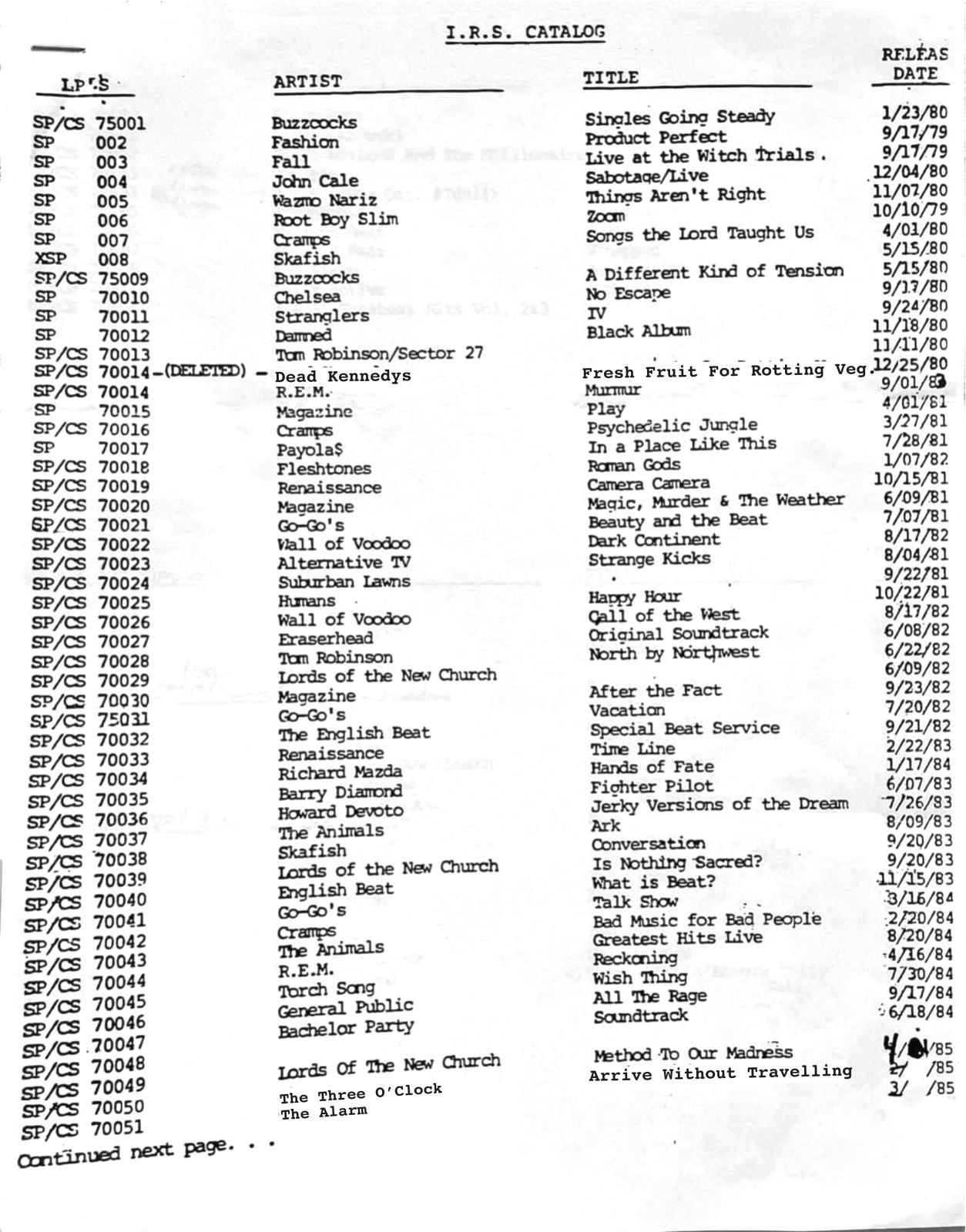
SP 70601 was originally assigned to Doing Time on Vinyl by various artists. This album was never released.
SP 70604 was reassigned to SP 70014 after a year in release and it was also marked at full price.
SP 70606 was to be the Hunters & Collectors album but A&M Records issued it with the Oz Records imprint.
SP 70014 was originally the Dead Kennedys album Fresh Fruit which was released on December 25, 1980. The first printing has an orange sleeve with both the I.R.S. Records and Faulty Products logos. The album was recalled and reprinted with the Faulty logo and "an I.R.S. Records company." The address for A&M Records, 1416 N. LaBrea was removed on the reprint.
I.R.S. Records release dates 1979-1985
EPILOGUE
In 1985, the United States Senate Committee on Commerce, Science and Transportation, held hearings on the "Contents of Music and Lyrics of Records. These hearings sparked by the Parents Music Resource Center (PMRC) and spearheaded by the wives of then-Senator Al Gore and then-Secretary of State James Baker. The PMRC had asked music publishers and record companies to label their products so that consumers would be forewarned of sexual, promotion of violence, drugs, alcohol and occult content. Al Gore stated the PMRC wanted, "a voluntary guide system for parents...to try to prevent their children from being exposed to material that is not appropriate for them."
The U.S. Government Printing Office printed the hearing transcripts of September 18, 1985 which included a Los Angeles Times article, "Parents Warn: Take the Sex and Shock Out of Rock." Written by Patrick Goldstein, it appeared on August 25 and contained Jay Boberg's statement representing I.R.S. Records' position. "I can't believe they're serious--I think this whole thing is ridiculous," said Boberg, 27-year-old president of I.R.S. Records. "I would fight to the death any review board that would rate our records. It's a complete intrusion of artistic expression and constitutional freedom of speech. It would be a very dark day if we were ever forced to go along with anything like that."
The article continued, "Boberg insisted that any ratings system would merely encourage kids to seek out albums that carried a warning tag. When you put ratings on things, it just arouses kids curiosity and makes them want to hear all the more. That's what happened with movie ratings. I know that when I was 16, which wasn't so long ago, if a movie was R rated, that just whetted my appetite to see what I was missing.'"
SOURCES:
www.ark21.com/about.html (defunct website)
IRS Names Accardo Natl. Publicity Dir. Record World, January 19, 1980.
A&M Working Out Snags In Unique Distribution Arrangement. Jeffrey Peisch. Record World, March 8, 1980.
Rx for College Record Cutbacks: 'Sell' Your Stations Labels Urge. Alan Penchansky. Billboard, November 29, 1980.
I.R.S. Names Staffers. Record World, March 14, 1981.
Copeland Deal For A&M. Music Week, April 4, 1981.
I.R.S. Names Two. Record World, April 11, 1981.
I.R.S. Names Zislis. Record World, September 26, 1981.
Studio Track. Billboard, April 3, 1982.
Retail Test for Go-Go's Cassingle. Billboard, June 26, 1982.
Faulty Products: IRS Indie Option. Sam Sutherland. Billboard, July 17, 1982.
Labels Hike Video Clip Production. Laura Foti. Billboard, July 24, 1982.
Inside Track. Billboard, February 5, 1983.
Copelands Join. Billboard, February 26, 1983.
Music Monitor. Laura Foti. Billboard, March 26, 1983.
Videolabels: the Record Companies of the Future. Billboard, November 19, 1983.
Variety. IRS Ankles A&M, Seeks New Distrib. December 12, 1984.
IRS Through MCA May One. Paul Grein. Billboard, May 4, 1985.
Go-Go's Gone; Lawsuit Looming? Ethlie Ann Vare. Billboard, June 8, 1985.
National Academy of Recording Arts and Sciences.
I.R.S. Alternative Again; Imprints Explore Genres. Chris Morris. Billboard, December 2, 1995.
Whitburn, Joel. Joel Whitburn's Top Pop Albums 1955 - 1996. Menomonee Falls, WI: Record Research, Inc., 1996.
Whitburn, Joel. Top Pop Singles 1955 - 1999. Menomonee Falls, WI: Record Research, Inc., 2000.
Copeland, Miles Two Steps Forward, One Step Back. June 22, 2021.
There are thousands of artists on the ON A&M RECORDS website. Click on a photograph to take you to a new artist!