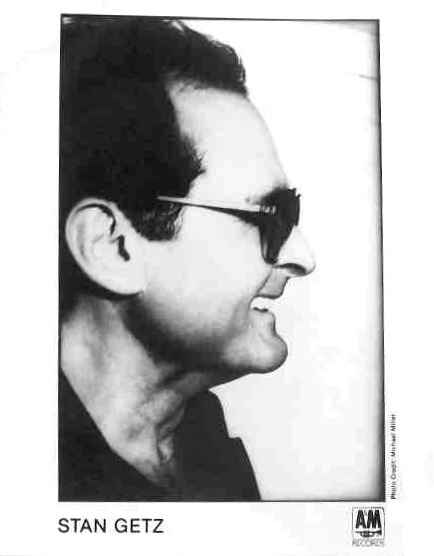
Stan Getz
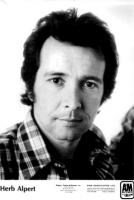
"I had a real ball doing Apasionado. We took our time. It was done in three days. I never took that long before. Well, we couldn't figure out what material to play. I got together with Herb [Alpert] and Eddie del Barrio--the composer and synth player who I'm taking to Europe. I went up to Herb's house every day for three weeks and sort of put the skeleton together. That was the preparation we had."
"When you see the results of playing an hour or two for people and they're happy about it and they enjoy it, that's quite an honor to be given--to make people happy for awhile."
"I thought about bettering the music, always trying to become good at the music. Which you never do, because what you hear in your head is better than what you do, always."
"[When I taught at Stanford] I spent the whole time trying to convince these kids that the main thing that makes jazz so good is that it's the expression of the individual. Don't belittle your own individual selves, stop imitating after awhile. Alright, you could tell that I played like Lester Young, but who you love you sound like for awhile. You've got to let yourself go on to your own thing."--Stan Getz, Cash Box, June 22, 1991
"[Jazz musicians] don't want to take something and play it because it's already been done. But I feel that music can be classic, too. Just nice music. Jazz music is supposed to be democratic music. Each man has a say in a jazz quartet. But they all must contribute to the whole. Egos have to be kept to a minimum. But you know jazz musicians. They're crying for attention. They always want something different."
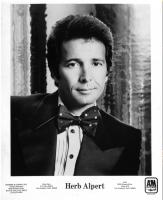
Stan Getz recorded two album with Herb Alpert producing them for A&M Records. The first was Bossas and Ballads: The Lost Sessions recorded over three days in the Spring of 1989. It was called lost sessions because it was recorded in 1989 but was not released until 2003. The reason for the delayed release was because A&M was not in a position to market a jazz album. Alpert and Getz moved on to create Apasionado with its Latin-jazz feel.
BOSSAS AND BALLADS: THE LOST SESSIONS
On January 11, 2004, Herb Alpert appeared on NPR Music to remember Stan Getz. Here is what he said.
“Stan had the it. Whatever that it is, Charlie Parker had the it, you know? A lot of musicians have that certain little something, that’s magical. I interviewed him several times, trying to squeeze out of him what is that thing you’re doing and as best as he could describe it, he said, “Lookit, jazz is not about licks, jazz is not about who can play the fastest or the highest, jazz is about a logical beginning, middle and end. It’s a total story. Besides from the fact fact he had a beautiful sound, that sound was just gorgeous.”
“He was a little skittish recording because he had gone through some chemo, was burning moxie in his belly button, and doing everything to get this cancer out of him…. There was a little fear because he hadn’t played under those conditions before. He always felt if he wasn’t stoned or wasn’t doing something that he couldn’t express himself in the same fashion and he found out that he could and it really didn’t change. It was as beautiful without.”
“When we met in person, when he asked me to produce the record, I said no I don’t want to do it. He said why and I said quite frankly I’ve heard horror stories about you, how you’ve treated musicians throughout the years and there have some things that have been said that I don’t want to be part of that. I don’t want that vibe around me. He said, ‘Man, believe me, I’m not that way anymore.’ He was so intent on making amends to all the people that he did offend cause he was—it wasn’t the real Stan coming out. I saw the real Stan. The real Stan was a gentleman. He was funny. He was a great friend. He was really a uniquely special guy.”
“As a tenor sax player, I don’t think there was anyone who could rival him. He was uniquely himself. He always went for that melody. Jazz is really taking a song and creating another melody on the same chord changes of that song. And he was continually looking for melodies.”
“We recorded for three days so we had like three or four different takes on each one. I’d listen to each one and find something beautiful on all of them. What a blessing it was for me to have known someone like that in my lifetime.”
OFFICIAL PROMOTION BY A&M RECORDS
Bossas and Ballads: The Lost Sessions press release
Bossas and Ballads: The Lost Sessions sellsheet
- Stan Getz Back on the Beach. Josef Woodard. Down Beat, July 1990.
- Off the Record: An Oral History of Popular Music. Joe Smith. New York: Warner Books. 1988.
There are thousands of artists on the ON A&M RECORDS website. Click on a photograph to take you to a new artist!