Quincy Jones
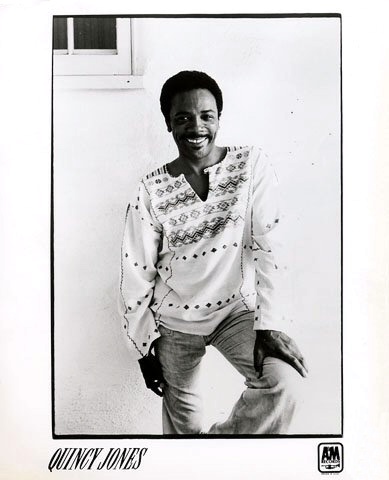
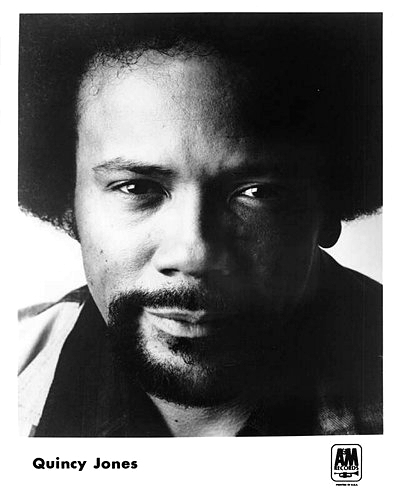
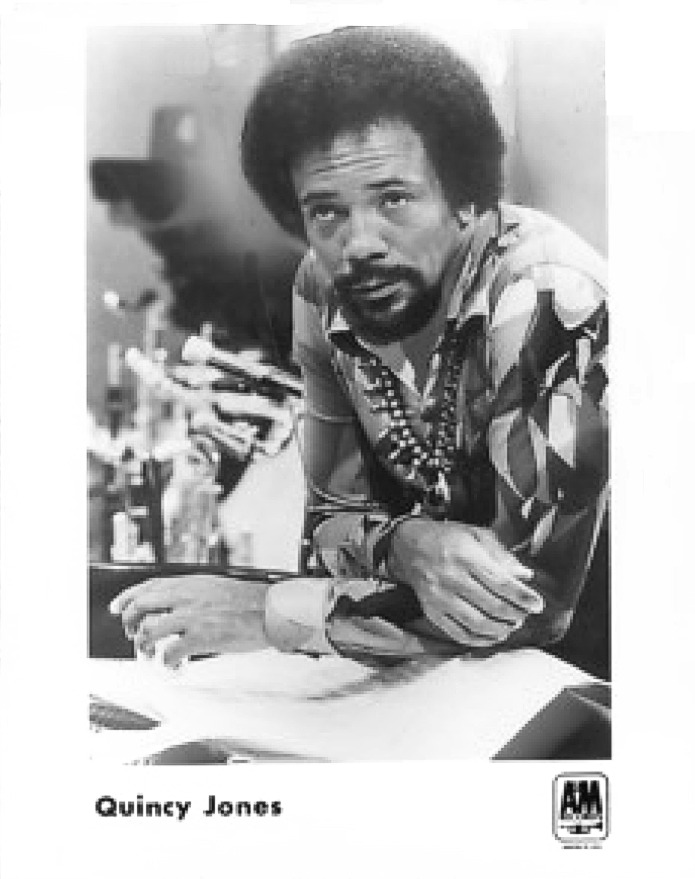
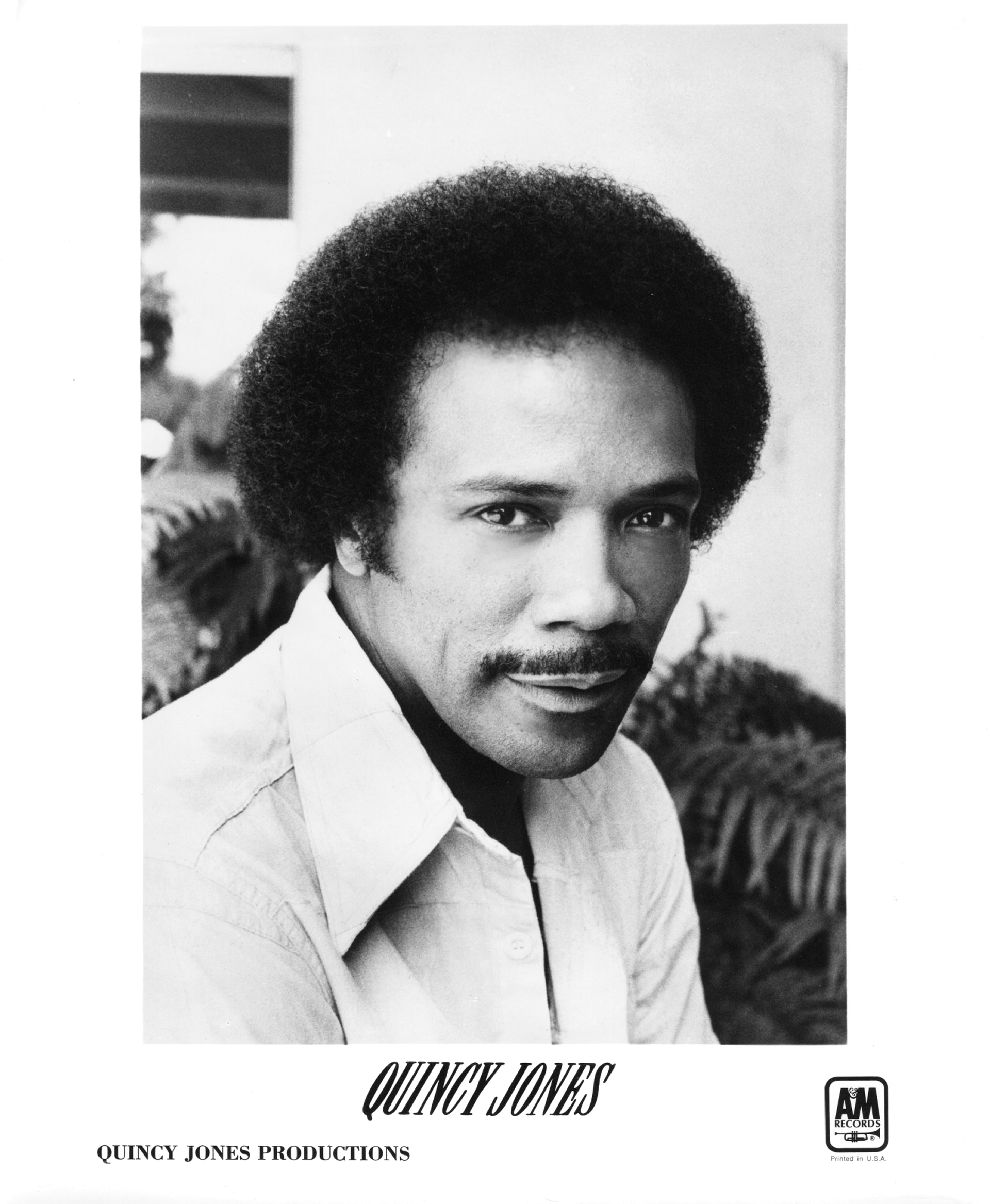
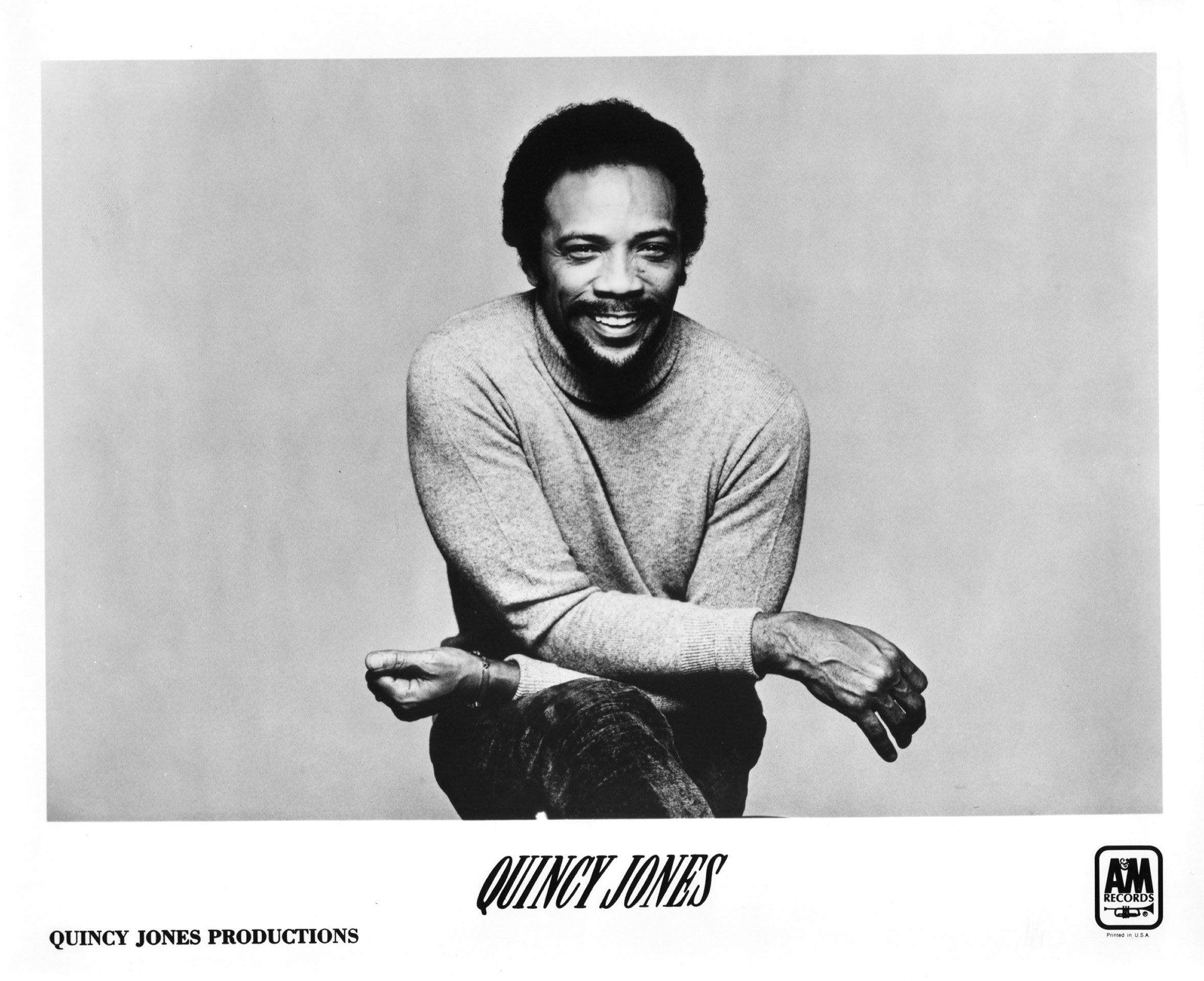

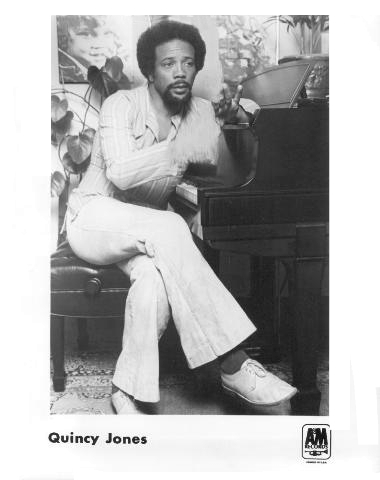
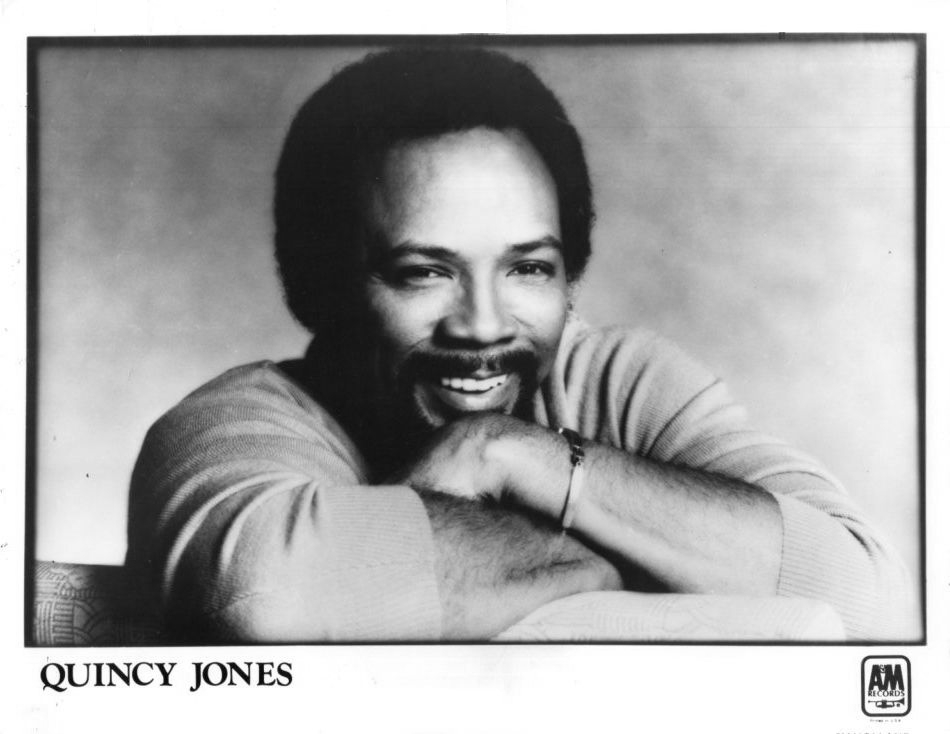
"I believe very strongly that the divinity and creativity is the most powerful force there is." (Billboard, December 16, 1995 page 24)
"I think the basis of communication is basically being sincere." (ibid page 36)
"We're in a strange industry; our product is consumed even before it's purchased...People hear a record and if they don't like it, they don't buy it." (ibid, page 26)
"Rod Temperton, Greg Phillinganes, Jerry Hey, Bruce Swedien on the mixing side...we've been together almost 20 years... Without them, you can't be that adventurous. We can try anything, and we do, we go for it. Paul Jackson, The Brothers Johnson...it's definitely a family." (ibid, page 26)
"I must say that it's the music first. But we all have this junkie attitude: we don't care what gets in the way, we're not stopping. No matter how long it takes, how many times we have to do it over again, nobody cares. That's a great feeling because everybody is going for the moon. We all have that in common." (ibid, page 26)
"Ideas are the sustenance of creative life." (ibid, page 28)
"...the trick is to dream real big. But if you do that, you have to get off your ass and execute real big!...I think our higher power likes our dreams to be very specific. Don't just say, "Oh God, I wish I was happy." Give me a break, man! I think when you start dreaming and visualizing, you've got to be very specific or it won't happen." (ibid, page 28)
"I wanted to write for films, since I was 11 years old....Henry [Mancini] was my mentor. When I got into films, he helped me on some musical fronts and on some sociological fronts too. He was always trying to push the components and elements of what Americana was about, orchestrated to use in a dramatic context. I used to love that challenge because you couldn't get it any place else." (ibid, page 28)
"Let's face it, the music business is about eighteen-year-olds. I remember in 1959, when I was broke, and I was doing three weeks in Europe with Nat Cole, and Nat said, 'Somehow it all works out. You can have a big spurt of five years, or else you can take your time, and just ease on for fifty years and get bigger all the time.' That idea just knocked me out."
"It was Ray [Charles] who took me aside and explained that every form of music has its own soul; a level of emotional and spiritual musical value that is valid no matter who plays it. He also told me that the true test of a great musician comes with the person who can capture the essence of the soul of classical, German, folk, or even country and western music and make it flow within his own style."--Quincy Jones, Ray Charles and I, July 20, 1976, The Baltimore Afro-American
WALKING IN SPACE (1969)
Quincy Jones signed to A&M Records in 1969.
Quincy Jones recorded his Walking in Space album in one week. It won the Grammy for Best Instrumental Jazz Performance, Large Group or Soloist with Large Group. The album was also nominated for Best Instrumental Arrangement.
During 1969, Jones worked on the music for six motion pictures, including John and Mary.
JOHN & MARY (1970)
Quincy released the John and Mary soundtrack as an album featuring A&M artist Evie Sands.
In 1970, Quincy participated in three more motion pictures.
GULA MATARI (1971)
>Gula Matari was nominated for three Grammy Awards: Best Instrumental Arrangement, Best Large Jazz Ensemble Album and Best Instrumental Composition.
While a recording artist for A&M, Quincy Jones served as the Musical Conductor and Arranger for the 43rd Annual Academy Awards in 1971. In 1971, four more motion pictures.
SMACKWATER JACK (1972)
The album Smackwater Jack won the 1972 Grammy for Best Pop Instrumental Performance.
YOU'VE GOT IT BAD GIRL (1973)
The album was nominated for the Best Pop Instrumental Performance Grammy. The single "Summer In the City" won the Grammy for Best Instrumental Arrangement.
BODY HEAT (1974)
The album was nominated in the Grammy category for the Best Pop Vocal Performance by a Duo, Group or Chorus.
MELLOW MADNESS (1975)
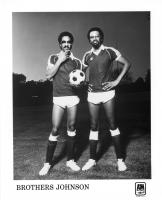
Recording sessions for the Mellow Madness album began in February 1975. Q wrote in A&M Records Compendium, "Mellow Madness was one of the most exciting albums I have had the pleasure of recording, for I was stimulated musically as well as being turned on to a couple of beautiful young cats who provide so much musical inspiration that it scares me. The two cats I speak of are my bass player Louis 'Thunder Thumbs' Johnson, and his guitar-playing brother, George 'Lightnin' Licks' Johnson." Those cats were known professionally as Brothers Johnson.
Jones, reuniting with Lesley Gore, brought her to A&M Records where he produced her album Love Me By Name.
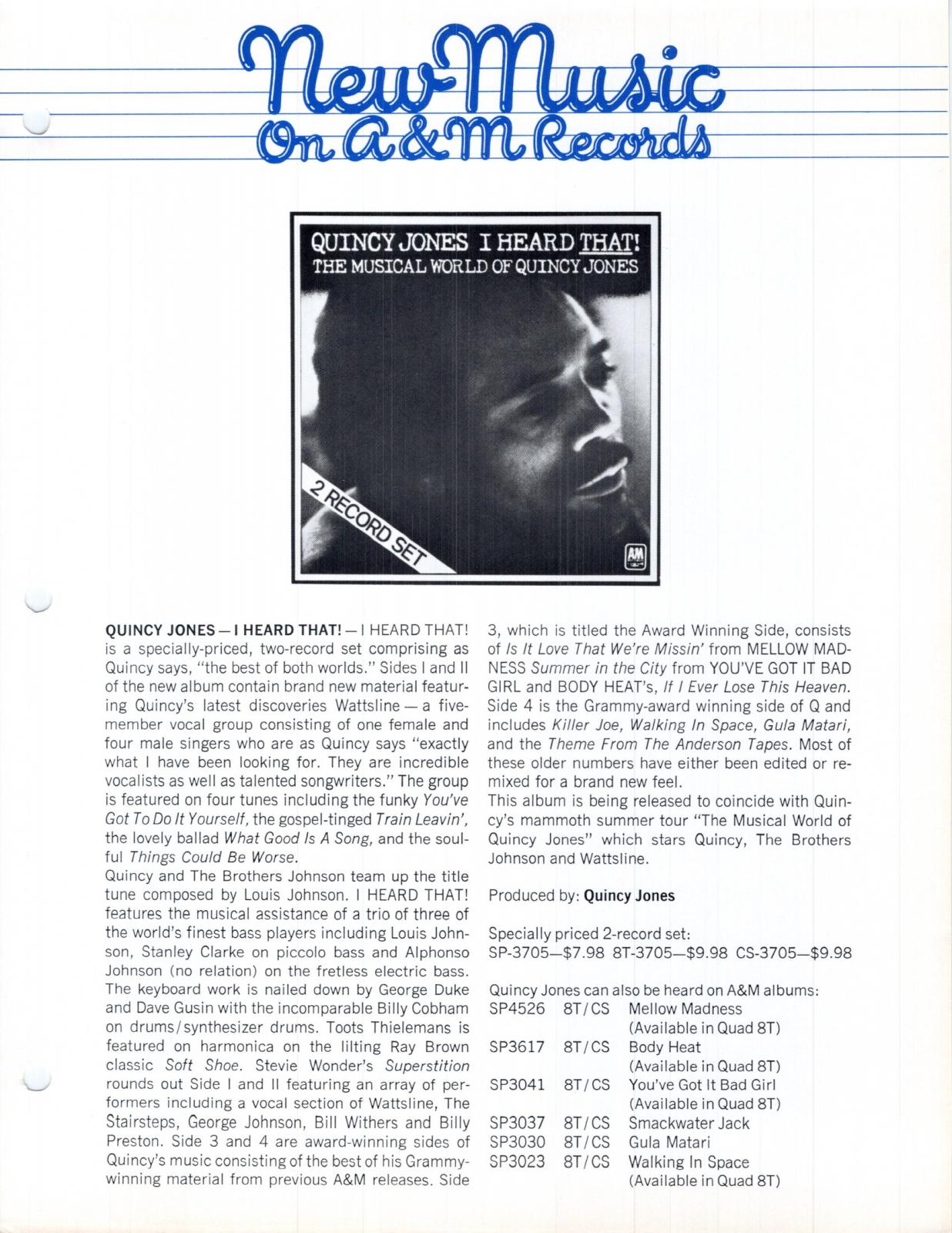
I HEARD THAT!! (1976)
Quincy Jones received his first platinum record in 1976 as the producer of the Brothers Johnson. Q's album I Heard That!! featured "Midnight Soul Patrol," a song he co-wrote with Louis Johnson and Johnny Mandel.
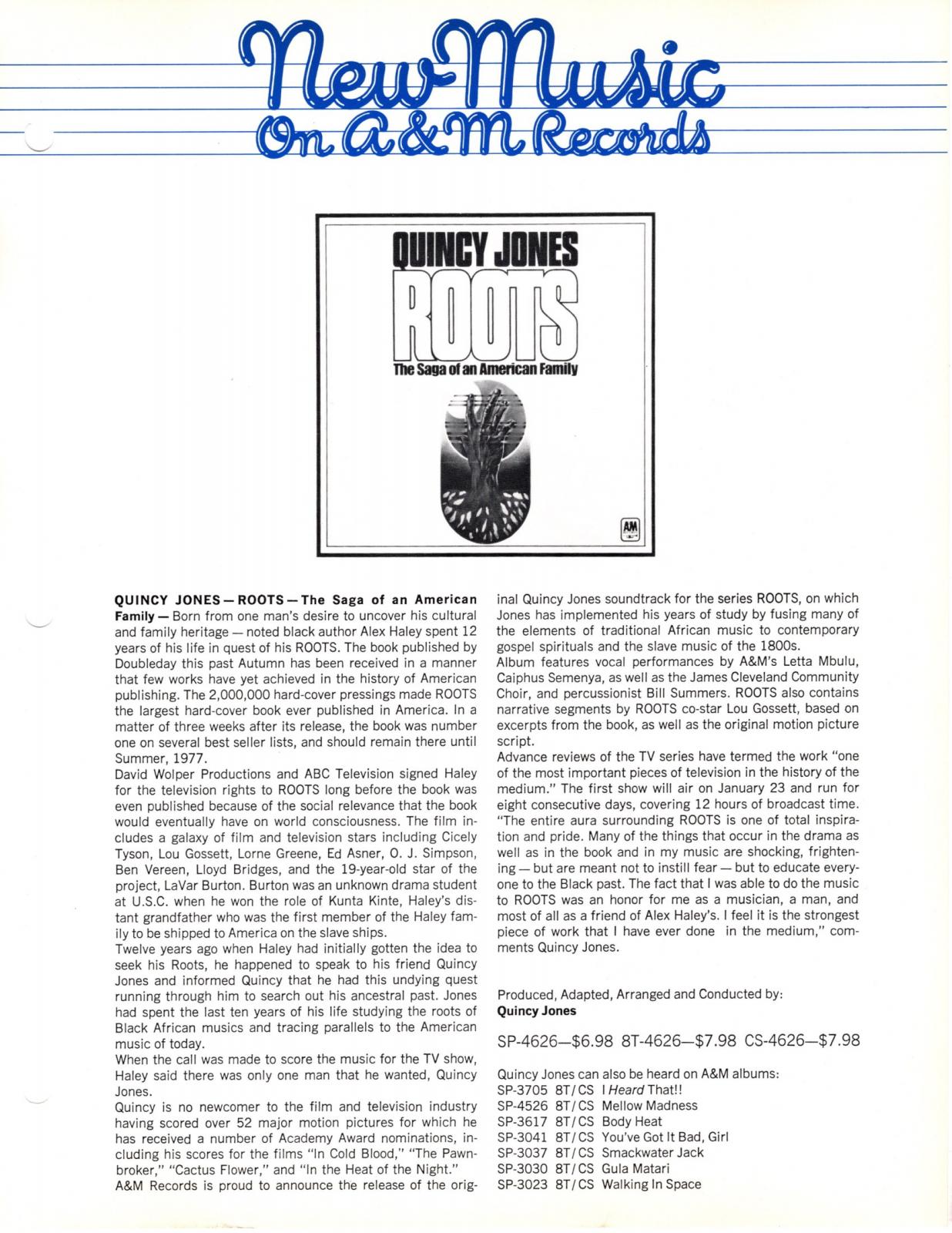
ROOTS: THE SAGA OF AN AMERICAN FAMILY (1977)
In 1977, Quincy Jones won the Emmy Award for Roots: the Saga of an American Family in the category of Outstanding Music Composition For a Series. Three tracks from the album were nominated for Grammy Awards: "Oh Lord Come By Here" in the Best Inspirational performance category and the Roots Mural Theme in the Best Instrumental Composition and Best Instrumental Arrangement categories.
THE DUDE (1981)
In 1980 and 1981 Jones was nominated as the Producer Of the Year at the Grammy Awards. In 1980, he produced the soundtrack for the motion picture "The Wiz" and in 1981 his album The Dude. The album was nominated for Album of the Year. contained "Ai No Corrida" and "Velas." "Corrida" won as the Best Instrumental Arrangement Accompanying Vocal(s) while "Velas" was the winner of Best Arrangement On An Instrumental Recording. "Velas" was also nominated as the Best Pop Instrumental Performance. The title track won Best R&B Performance By a Duo or Group With Vocal.
WE ARE THE WORLD (1985)
When he produced "We Are the World" in A&M Studio A in 1985, there was a sign that read "Check your ego at the door." Quincy had used that thought in many of his sessions. As he told Billboard in 1980,"...no star trips. That's the one thing I can't stand at sessions. We have an imaginary sign that says 'Check Your Ego At The Door.'" The song won the Grammy for Best Pop Duo Or Group Performance and Record of the Year.
For his music career, Jones was the recipient of three special Grammys: the Trustees Award (1989), the Legend Award (1991) and MusiCares Person of the Year (1996)/
TELEVISION THEME SONGS
Ironside (1967-1975)
The Bill Cosby Show (1969-1971)
Banacek (1972-1974)
Sanford and Son (1972-1977) "The Streetbeater"
Rebop (1976-1979)
OFFICIAL PROMOTION BY A&M RECORDS
Mellow Madness New Music On A&M Records
I Heard That! New Music On A&M Records
Roots the Saga Of An American Family New Music On A&M Records
20th Century Masters press release
Quincy Jones biography 1970s
Quincy Jones biography 1979

Official website: quincyjones.com
- Big Band Arranger Quincy Jones Moves Into Realm of Voices and Smaller Groups. Leroy Robinson. Billboard, June 29, 1974.
- Quincy Jones, 30-Year Veteran, Now a Top Versatile Producer. Paul Grein. Billboard, February 23, 1980.
- Off the Record: An Oral History of Popular Music. Joe Smith. New York: Warner Books. 1988.
- Quincy Brings Us Up to Date. Quincy Jones. A&M Records Compendium, October 1975.
Official autobiographies:
The Complete Quincy Jones: My Journey & Passions: Photos, Letters, Memories & More from Qs Personal Collection
Q: The Autobiography of Quincy Jones
There are thousands of artists on the ON A&M RECORDS website. Click on a photograph to take you to a new artist!